


The Urgent Need for Reform in India’s Infrastructure
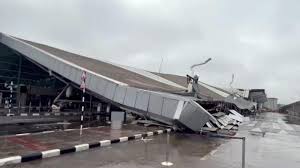
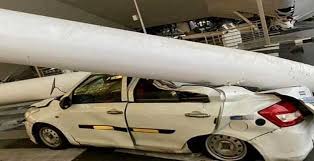
On 28th June, 2024, 45-year-old Ramesh Kumar went to Delhi Airport to drop his customer. He was working overtime because he wanted to save money for his elder daughter’s wedding. As soon as he drops the customer, the roof of Delhi Airport’s Terminal 1 falls on his car and he dies.
One day before, on 27th June, 2024, the roof of Jabalpur’s recently inaugurated airport fell. On 1st July, two people were killed in Mathura when a 250,000 litre water tanker fell.
The gutters of Gurgaon have become fountains. All the records in Bihar have been broken that in the span of 15 days, 7 bridges have fallen. Life in India is so cheap that as soon as you step out of the house, either a hoarding will fall on you, or the roof of the airport, or the bridge will slip off your feet.
According to government data, between 2018 and 2022, 8500 people have died as a result of an infrastructure failure. So who’s responsible for this? What’s so bad about India’s infrastructure?
To understand why the infrastructure in our country is so bad, we need to understand the process of an infrastructure project. First, a contract is given to a company.
Then the company designs and executes the project. After that, the infrastructure needs to be maintained. For this, we need to conduct safety audits.
But with India’s infrastructure, problems start at the contract stage. The main reason for this is that our government uses L-1 contracts. What are L-1 contracts? Let us give you an example.
India’s Infrastructure -Girish Park metro station in Kolkata
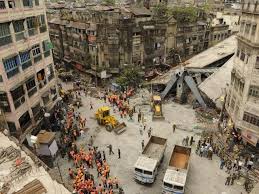
On March 31, 2016, at around 12.30 pm, near the Girish Park metro station in Kolkata, there was a huge crowd on Vivekananda Road. Some people were going to work, while others were going for lunch break. But at the same time, an under-construction part of the Vivekananda flyover fell on people and 26 people were injured India’s infrastructure
IIT Kharagpur also said in its report that the company tried to save costs at every level, due to which the flyover fell. But this isn’t a single incident. On October 30, 2022, the Morbi Bridge in Gujarat collapsed, which killed 140 people.
In the Morbi Bridge in Gujarat, a cable bridge built on the Machchu River broke down on Sunday evening. During this incident, many people standing on the bridge fell into the river. And the Gujarat government gave the 100-year-old suspension bridge repair contract to a local company, Oreva.
But Oreva’s main business was to make clocks and lighting. The renovation contract was given to a company that makes clocks, calculators, not constructions, and certainly not bridges. There was no evidence that the company had experience in repairing bridges.
And this is a systemic problem in our country because our government uses the L-1 method to issue contracts. The L-1 method is the lowest-cost method. That is, the contract is issued to the lowest-cost bidder.
It doesn’t matter what the contractor’s experience or quality is. In fact, a report by the Indian government showed that many projects fail due to this method. In 2002, the Central Vigilance Commission, a government body, said in its report that many contracts are issued to companies that don’t have any qualifications India’s infrastructure.
And this is due to the L-1 method. Many companies make a fake budget to win a contract where they intentionally show a low cost for everything. If they show a low cost, they’ll win the contract.
And this is what happens. It’s not that the government isn’t trying to change this India’s infrastructure. On October 29, 2021, the Finance Ministry made new guidelines for contracts India’s infrastructure
It said that the contractor’s quality will be checked before giving them the contract. This system is called Quality-Low-Cost-Based Selection. But in its press release, the ministry also said that this system won’t replace the traditional L-1 system.
Instead, it’ll be used in a few cases. For example, in 2021, the government said that this new system will only be used for contracts whose value is less than Rs. 10 crores.
Two years later, this change was made. But the government didn’t say that the new system will be used in every project. So even today, the L-1 system is used to develop infrastructure.
Even in this new system, the contractor’s criteria aren’t evaluated. India’s infrastructure.
Does a government minister go to the cheapest contractor to build his house? Or does he go to a contractor whose quality and budget are good? If our ministers use this system for their homes, shouldn’t they use the same logic for our country’s infrastructure? The India’s infrastructure system that millions of people use. But the government isn’t doing that. In order to save money in the short term, it’s compromising the lives of its citizens in the long term.
The solution is simple. Many researchers have written about this solution. It’s the Multi-Criteria Contractor Selection Framework.
Many things of a contractor will be evaluated. Be it bid price, financial capabilities, technical capabilities, experience, performance, or health safety. India won’t be the first country to implement this system.
The same system is used in the US and Europe. But the problem is that it’s difficult to get into this system. Even if a contract is given, companies make the second mistake India’s infrastructure
They don’t design the infrastructure properly. For example, on June 2022, PM Modi inaugurated the Pragati Maidan Corridor Project.
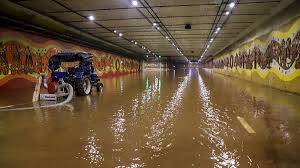
It cost Rs 777 crores. The PM said that a magnificent tunnel was built in such a short time. It wasn’t easy to build this integrated transit corridor in such a short time India’s infrastructure
But what happened after two years? This tunnel became useless. Look at the condition of the Pragati Maidan Tunnel. It wasn’t easy to build this integrated transit corridor in such a short time.
In fact, in the monsoon season of last year, this project was non-operational for the general public because the water was blocked here. So a project was built with Rs 800 crores spent. And in two years, it became useless.
It was said that many advanced facilities were used in this tunnel, like automated drainage. But the Public Works Department said that there were many technical and design mistakes in this project. There were many problems in terms of cracks, drainage, and water seepage.
Archit Pratap Singh, an urban planning expert, said that to build a good underground tunnel, you need to look at the conditions of the soil and rock properly. But this Pragati Maidan Tunnel didn’t have this. Because of this, the waterproofing was useless.
Water seepage was a problem in Bihar as well. The bridges here are falling apart like leaves. Only two weeks ago, the monsoon reached Bihar.
How much money was spent? Rs. 1,700 crores. Construction engineer Soni Yadav said that these bridges were not properly soil-tested India’s infrastructure
Why? Because the contractor wanted to save money. And there’s corruption in Bihar. Like Prashant Kishore says that if you spend Rs.100 to build a road, 40 gets stolen, and the road costs Rs. 60. But we shouldn’t blame the budget.
Look at our space organization ISRO. Its budget is far less than that of other space organizations. But the accomplishments are so good.
There’s a reason behind that. It’s the technical quality of its staff, which is currently missing in the India’s infrastructure industry. Soni Yadav says that local contractors don’t follow the blueprint and instructions properly India’s infrastructure
Whereas in Japan, if a building is built that’s more than 5 stories, the government agency has to get a structural and aerodynamic certification. And using wind tunnels and simulations, heavy testing is carried out to see if the new building will be able to stand there or not. For India’s infrastructure technical requirements, our country needs good engineers.
And I’m not talking about software engineers. Software engineering won’t make bridges and flyovers.
Even amidst so much unemployment, there’s a shortage of engineers and techies in big construction companies like Lassen and Turbo. L&T says that the problem is that skilled engineers go to the Middle East because they get good pay and a good work environment. Only those engineers survive in our country, who don’t have the skills.
We need to fill the skill gap or the contractors will keep making mistakes. And even when they do, they don’t get caught due to poor auditing. For example, in 2019, Mumbai’s foot-over bridge collapsed which killed six people. Six months before the incident, Mumbai’s Municipal Corporation BMC submitted an audit report stating that the bridge is fit to use but requires minor repairs. This audit was conducted when three years ago, another bridge collapsed on the Mumbai-Goa highway.
And BMC contracted a company to audit the 314 subways, skywalks, and bridges in Mumbai. The audit said that 14 out of 314 bridges should be demolished, 47 bridges need major repairs, 176 bridges need minor repairs, and 77 bridges are fine. And this CSG bridge was one of those 176 bridges which was considered fit to use with minor repairs.
Had minor repairs been required, would this bridge have collapsed in just six months? But after this incident, another BMC report stated that the audit was not conducted properly. Then Mumbai Police arrested Auditor Neeraj Kumar Desai whose company had declared the bridge safe despite the corrosion in the structure. Two engineers from the BMC’s Bridges Department were also arrested for not performing their duties properly.
And this is just one example of how lightly our government officials take public safety seriously. The same happened in Delhi. After the Delhi airport collapsed, the minister was asked if it was clear in the collapsed roof that the pillars were corroded.
The aviation minister said that he’d check if the safety audit was conducted properlywith that India’s infrastructure. The problem is that there’s no organization in our country responsible for safety audits. So whenever a roof or a flyover collapses, the government either fires or arrests people.
But there’s no structural change in our government. We saw this in the case of Gujarat. When the Morbi Bridge collapsed, the Municipal Authority found out that the bridge had been opened without a clearance certificate.
Nine people were arrested including a ticketing clerk and three security guards for not regulating the crowd properly. But no one in the government took responsibility. In fact, a few weeks ago, the Gujarat High Court asked the Gujarat government if they should submit an action-taken report after the formation of a special investigation team.
But that didn’t happen. In fact, the state high court is asking the government who’s responsible for this. If the state high court doesn’t know, then who are we? What’s happening with your money can only be seen from the Pragati Mehtan Tunnel in Delhi.
After the tunnel became useless, the Public Works Department filed a fine on the Larsen & Tobau Company. They said that the project had many serious technical and design errors. After that, the L&T put a counterclaim of Rs.
500 crores on the government. Now, they’ll fight over who’s at fault when your life is at stake. The accountability problem in Delhi is even more serious.
After a rainy day, Delhi was completely shut down. It’s true that it rained heavily but the government didn’t even prepare properly. Instead, it predicted the situation and said that the Delhi government should remove the dirt from the 22 open tunnels to clear the blockage.
But the Delhi government said that out of the 22, only 3 tunnels are controlled. 19 are under other departments. And that’s true.
And that’s the main problem in Delhi. People don’t know who’s controlling what. There are 4,000 km of stormwater drains in Delhi controlled by 8 different authorities.
Now, who will be held accountable? Who will be yelled at? The same goes for roads and bridges. Indian Railways manages the railway bridge. National Highway Authority manages the national highways.
Border Road Organization manages the border areas. State Highways are managed by PWDs. So people don’t know who’s working in which division. this is India’s infrastructure governance.
And if a drain is open in Delhi, do we know which authority to call out of the 8? That’s why the High Court said that we should fix this responsibility on one authority. Because Indians’ lives aren’t as cheap as our governments claim.
For more such information, please visit our news category


Leave a Reply